AMD Siren Halo APU Rumored to Include Dedicated GDDR7 VRAM
AMD Siren Halo APU Rumor Suggests Dedicated GDDR7 VRAM
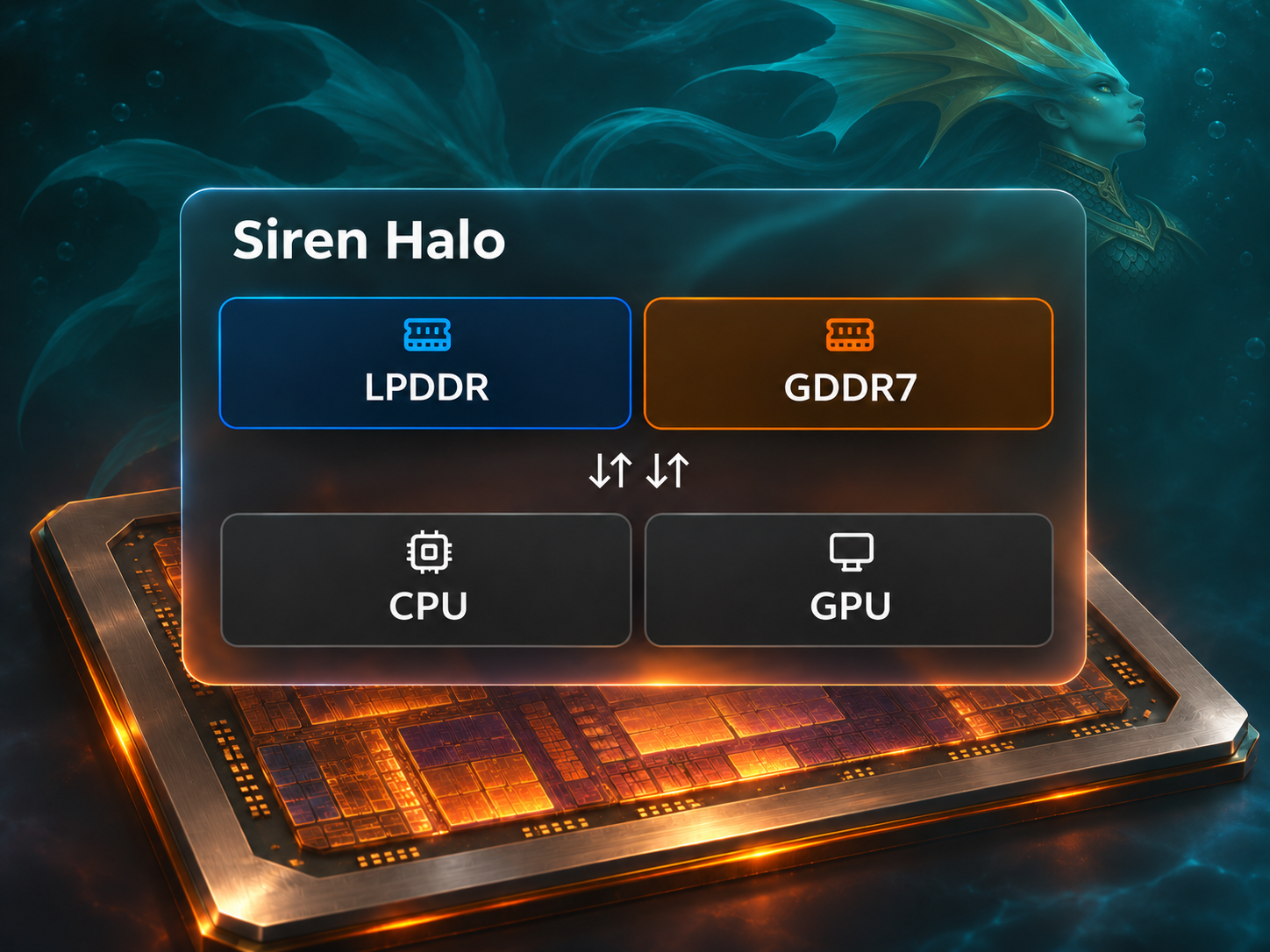
A new leak circulating in the hardware community points to an upcoming AMD accelerated processing unit codenamed Siren Halo that may break from traditional APU design by incorporating dedicated GDDR7 video memory alongside standard LPDDR system memory. The information originates from a report by Notebookcheck citing unnamed sources and has not been confirmed by AMD. As with all unannounced hardware details, the specifications and even the existence of this product remain speculative.
What the Leak Claims
According to the report, the Siren Halo APU would feature a memory architecture that pairs high-bandwidth GDDR7 graphics memory with lower-power LPDDR system memory. This approach would mark a departure from conventional APUs, which typically rely solely on shared system memory for both CPU and GPU tasks. Dedicated graphics memory on an APU could provide a significant bandwidth advantage for integrated graphics workloads, potentially narrowing the performance gap with discrete graphics solutions in certain scenarios. The leak also mentions possible adjustments to AMD’s internal Medusa roadmap and a speculative link to the silicon planned for Microsoft’s next-generation Xbox console, though neither claim has been substantiated.
GDDR7 and LPDDR Memory Context
GDDR7 represents the latest generation of graphics double data rate memory, offering higher data rates and improved power efficiency compared to GDDR6. It is currently deployed on high-end discrete graphics cards such as Nvidia’s GeForce RTX 40 series and AMD’s Radeon RX 7000 series. LPDDR, or low-power double data rate memory, is commonly used in laptops and mobile devices for system memory due to its energy efficiency. Combining these two memory types on a single package would require advanced packaging technology and a memory controller capable of managing both interfaces simultaneously. Such a design would be complex but not unprecedented; Apple’s M-series chips, for example, use unified memory with high bandwidth, though not separate GDDR and LPDDR pools.
Medusa Roadmap and Xbox Connection
The Medusa roadmap referenced in the leak appears to be an internal AMD planning document for future APU and SoC designs. Changes to this roadmap could indicate shifts in product strategy, timing, or target markets. The suggested connection to next-generation Xbox silicon is plausible given AMD’s long-standing partnership with Microsoft on custom console processors. The current Xbox Series X and Series S use custom AMD Zen 2 and RDNA 2 based SoCs. A future console would likely leverage newer CPU and GPU architectures, possibly with enhanced memory subsystems. However, console hardware plans are typically guarded closely, and any leak linking a specific APU codename to an unannounced console should be treated with extreme caution.
Unconfirmed Status and Industry Implications
It is important to emphasize that none of these details have been officially announced by AMD. The source material explicitly states that the claims are unconfirmed. Hardware leaks often contain partial truths, outdated information, or entirely fabricated details. If the Siren Halo APU with dedicated GDDR7 does materialize, it could signal a new class of high-performance integrated graphics aimed at gaming laptops, compact desktops, or even handheld gaming devices. It would also represent a notable evolution in APU memory architecture. Until AMD provides official information, the rumor should be regarded as an interesting data point rather than a reliable product preview.